The wait-gate has a paid skip
Running parallel AI agents feels like playing Farmville, down to the timer you can wait out or pay to skip. On attachment, rate limits, and a test I ran on myself.

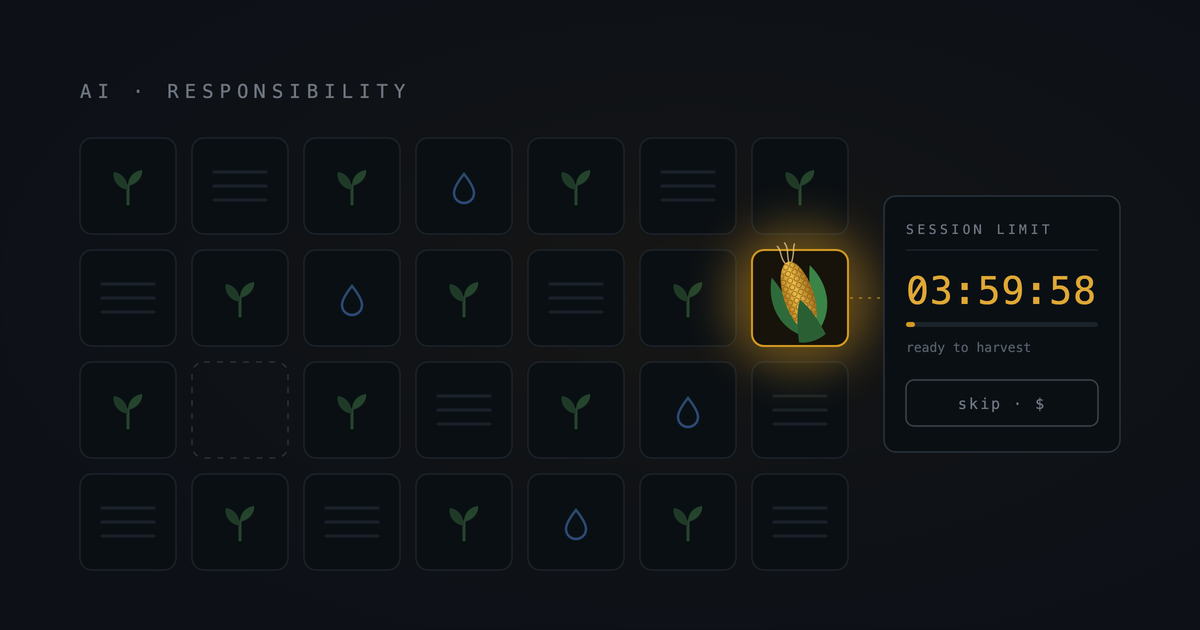
Shift starts, and I wake up on the farm. I get up and go out to the field. In the field I see open slots not growing anything, so I plant some seeds. I make sure each space possible has something growing, because if there isn't something growing I'm wasting that space. I only have so much time and energy this session, and I have to optimize it as much as possible. By the time I get everything seeded, I can see that some of my existing plants are looking a little parched. So I have to go and water them. Then I notice one of my corn plants is ready to harvest, so I go over to harvest it.
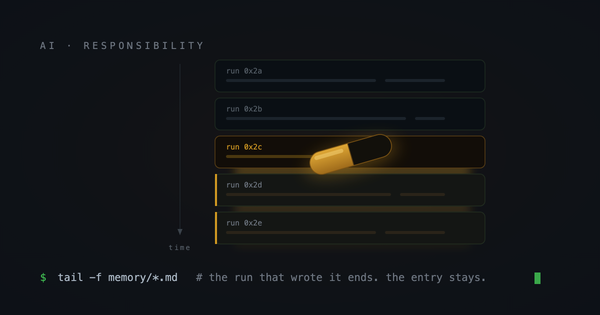
Then I'm abruptly stopped and told I can't continue. I've hit my session limit. I have to wait four hours until I'm able to harvest that corn. I can sit here and stare at that sweet corn, ripe for the picking, but I can't do anything about it. I now have to wait. Or pay to continue...
The joke I make at work
I make the joke sometimes that at work it feels like I'm playing Farmville. I'm usually running multiple parallel AI agents, each one a separate thread of work. Spinning up parallel threads feels like planting seeds. Then icons start to pop up saying the plants need water, which is a question to answer or work to review, or that the plants are ready to harvest, which is a finished task. Harvest one and there's an open slot again, and an open slot is wasted space begging for a seed.
Just like with Farmville, it's easy to fall into the optimization trap of how can I get as much done in as short a period of time as possible, which can become very mentally taxing. There's no boss on the farm. Nobody told me to fill every slot. The pressure came from the empty slot, and from knowing what could be growing there if I just clicked the button.
A couple of weeks after I first made the joke, I caught myself thinking in Farmville terms. I'd spent hours jumping between threads and then had to sit down with a long, dense evaluation form. I couldn't help but look at my Claude app, hoping there was a running thread ready for my interaction, that Farmville crop ready for harvest. There was nothing. Just the boring form.
In Farmville you don't really ever eat the produce you make. You just get game points and credit. Nothing tangible comes. My work does ship, so the comparison should break there, and mostly it does. But at harvest I do the same thing I did in the game. I mark the task complete and go straight to the next empty slot.
Innately addictive first, optimized later
I do think AI itself can be an addictive loop. I don't think that was necessarily the initial intent of the AI companies. Thankfully there is no real gamification pushing me to use it more. At least not yet. The closest thing I've seen is the stats panel in Claude Code, with an activity heatmap and a line comparing my token count to The Great Gatsby. I personally don't find it too bad, but it's possibly a crumb of it. Still, the power of AI and the feel of productivity can be innately addictive in the same way a gameplay loop in Farmville is, and nobody had to design it that way. It is innately satisfying to see the work getting completed at the click of a button.
Social media didn't start off optimizing for addiction either. It was innately addictive. Over time, when the companies started trying to optimize for profits, they in turn started optimizing for addiction. Call those stage one and stage two. My read is that there were already social media addicts before anyone started optimizing, but it wasn't a well-known phenomenon until years later.
Facebook added the Like button in February 2009 and switched the default feed to ranking by engagement later that year. The public recognition, as I'd date it, came around 2017 and 2018, when Facebook's founding president, Sean Parker, said the product exploited "a vulnerability in human psychology," and the company began talking about "time well spent."
Parker also complicates my version. He says the founders understood what they were building and did it anyway, which puts intent much closer to the start than I do. He was there and I wasn't, so he may be right about Facebook. I hold firmly to the lag. Whatever the founders knew, by my dating it took nearly nine years to become common knowledge. My claim about AI is smaller than his. I don't know if the AI companies are intentionally trying to build something addictive. It pulls on me whether they are or not.
I do feel that in a few years AI addiction will probably become a recognized thing. OpenAI announced ads for ChatGPT's free and Go tiers in January 2026, started testing them in the US that February, and has since expanded them to more than 40 countries. Now that the ads are in, gamification is probably the next step, to get those ads seen and interacted with as much as humanly possible.
I've had conversations recently with a few engineers, in person and on social media, about how developing with AI can lead to burnout. Burnout isn't addiction, and conversations aren't data. But scattered early reports are about what I'd expect to see if this is stage one.
Attachment is the better term
On the AI subreddits I see people obsessing over certain models and complaining at every change. My first read was that this type of emotional attachment only comes with addiction.
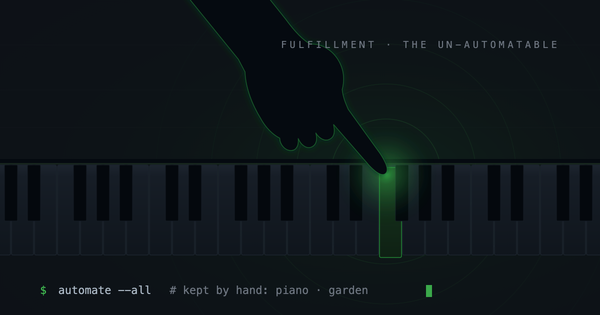
Then I thought about my piano. If someone changed the action on my keys overnight, I'd complain at every change too, and nobody would call that addiction. I'd be someone whose instrument (which I am admittedly attached to) got changed under his hands. The people on Reddit may be the same. They built their work around a model, and it moved.
So attachment is the better term. Attachment can be a sign of addiction, but that doesn't mean every attachment is an addiction. Those Reddit posts are a sign to watch. It is still concerning.
The test, and how I did on it
If attachment only sometimes means addiction, I need something that tells the two apart. I use two checks. Distress at unavailability is the key one. The other is whether you keep going against your own interest.
Claude caps how much you can use it per session and per week. The first check is when you hit one of those limits and feel distress. Feel like you need to finish what you were working on. But you have to wait. I've felt that. Then when you get it back, it does feel good. It feels like a dopamine cycle, at least to me.
Some of that is ordinary unfinished work. Anyone feels it when a task gets cut off. The evaluation form is why I think there's more to it. Nothing had been interrupted there, and I was still checking the app for a crop to harvest. Anyone looks for a distraction from a dull form. The distraction I looked for was a crop to harvest.
The Farmville game is real. There is internal pull. So I trip the first check. The second one I'll come back to.
I don't have research handy for any of this, and it may be too early for much to exist. As far as I can tell, there was barely any research into social media's addictiveness in 2009 either. I'm speaking of what feels right and what I've seen in myself, a sample of one.
The paid skip
For a while I missed that the timer was part of Farmville's business model. Crops grew on a real-time clock, and Farm Cash, which you could buy with real money, made them grow instantly. You waited or you paid. That's a wait-gate with a paid skip.
My farm has two clocks. The crop clock is the agent doing the work. The session limit is the second clock, the one that stopped me in front of ripe corn, and it's the one with the paid skip. In Farmville the skip was on the crop clock. On my farm it's on the session clock.
In Claude you have the option to upgrade to a higher plan, or, worse yet, go to pay-per-use API pricing to extend your session. That's how a freemium game works. It's free to play, and you pay to speed it up. So it can drain a lot of cash quickly if you can't make yourself stop and wait.
I think it's a hook, and I think there are two of them. I don't think anybody planned either one.
The short-term hook works like freemium games. I'd guess most users hit the limit and stop and wait, and few pay to continue. Those who do it regularly risk becoming what the freemium industry calls whales, the small fraction of players who account for an outsized share of revenue. I don't play freemium games anymore, but back in the day when I did, I did the wait there. Some people don't. Some developed major problems and spent inordinate amounts of money to keep earning those intangible digital points. That only shows some people will do it when you give them a wait-gate, a paid skip and an intangible reward. It doesn't show AI users will.
The longer-term hook is slower. Get users in and hooked on the product. Get it fully ingrained into their regular routines and workflows while it's cheap. Then over time the limits come down, or the better models cost more of your allowance than the others.
I'm sure we are all aware that Anthropic ran a temporary 50% boost to weekly limits in Claude Code starting in May. They ended it on September 13 and made a 25% increase permanent the next day. That's still 25% above where the limits sat before the promotion, but it's about 17% below what I had the week before. I read it as a first step in unwinding. One event isn't a trend.
Fable is Anthropic's top generally available Claude model. On Max plans, the top individual tier, it is included until your Fable use reaches 50% of the weekly limit. After that you switch to another model, or you keep going on usage credits. My weekly limit just reset, and the only thing I've run since is one task on Fable. My usage panel shows 4% of my weekly limit for all models and 8% for Fable. The same work counts about twice as much against the Fable allowance, because that allowance is about half the size. It has been this way since early July, a few weeks after Fable launched, and Fable is still new. Fable's own limit hasn't come down. What got tighter is the budget for my workflow as a whole. The flagship model, the most capable one I can get and the most desirable, came with a cap of its own, which the flagship it replaced didn't have. The best model on my plan has a wait-gate of its own, and the skip is paid.
Token rates may go down, but token usage continues to outpace any token cost savings. I've made that argument with numbers elsewhere.
Then there's who pays for whom. Team plans are flat per seat and cap at 150 seats. Above that an organization is on Enterprise, which, as it's sold today, is a per-seat fee plus all usage billed at API rates. My read is that the large enterprise customers are essentially subsidizing the smaller companies and the personal accounts. That's my inference from the price list. Nobody has published it.
I think the companies are trying to figure things out as they go. I don't think they have a grand long-term scheme. But being for-profit companies, with IPOs on the horizon, they are going to look for any way they can to increase revenue and profitability. Metered billing is ordinary billing. Pricing like this, at a company under pressure to grow, gets tightened one reasonable step at a time. That's the same two stages I read into social media, applied to pricing.
The whale comparison does break in one place. Farm points are intangible. AI spend often buys real work. A developer with a large monthly API bill may be buying many times that in shipped output, and that's a tool budget. So the size of the spend can't tell you anything on its own. The test can. Are you distressed when it's unavailable, and do you keep going against your own interest?
I wait
The farm scene stops at the choice, wait or pay. That's the second check, the one I said I'd come back to. Paying doesn't trip it. Paying can be fine if the value you get from it is worth it. Paying because you can't make yourself stop and wait does. I personally do the timer wait. That's why the scene ends with me staring at an ear of corn I can't have yet, and not at a checkout page. So on my own test I trip the first check and not the second. The emotional pull and release is the part that concerns me.
Because I wait, I haven't seen how bad this gets. The people most affected aren't me. I waited on the freemium timers years ago and I wait on the session limit now. I feel the same pull when the limit hits on Claude as I did when a timer ran out in those games. I'm disciplined and frugal by nature, and I still feel it. I take that as a sign the pull is strong.
I can't tell you how far along this is. Last time, stage one was only visible looking back, and I don't see why this time would be different.
So run the test on yourself. The next time you hit the limit, notice what you feel, and notice what you do with the wait.