The last reader
A senior engineer's last code review, and my answer to the question it raises: should a human ever have to read the code again?

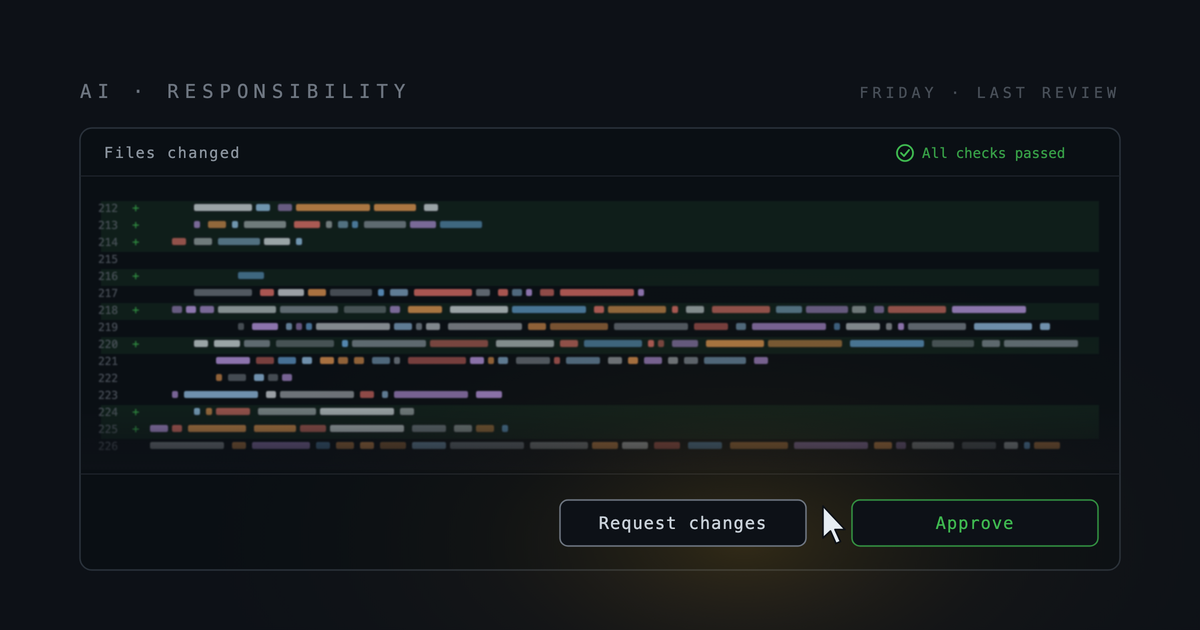
It's Friday afternoon, and a senior engineer is doing the last code review of their career. Starting Monday, no human at the company reads the codebase. AI writes, reviews, and maintains it, and people judge only the features that ship and the evals (automated tests that score the output) that run against them.
One pull request (a proposed code change waiting on a reviewer's sign-off) is left. All the tests pass. The feature works as it should. And the engineer can't follow it. Strange names, a lot of dense logic they can't quite wrap their head around. They could open Claude and have it explain what the code is doing. It could even review it for them.
But after twenty years, this is the last hurrah. It's strange how a career can vanish almost overnight. They still have a job. They still have the same title and pay. But everything they do on a daily basis is completely different than it was two years ago. They spent so much time building a craft, and now, just like that, it's gone.
So the cursor sits between two buttons. Approve, and give in. Or, this one last time, request changes and force it to write code they can clearly understand.
This is something I've been contemplating for a while. I think this is where it's heading, whether we want to accept it or not. Personally, after building my own agentic harness (the tooling, checks, and evals that let AI agents build software) over the last year, I think the human code reader should retire, and that we lose less than we think in the process.
Why engineers keep reviewing
Most engineers I see, in the industry and elsewhere at my company, haven't taken themselves off the review gate (the human sign-off a change waits on before it ships). Part of it is that humans are resistant to change. Another part is that humans like to feel in control. Even when AI writes perfectly fine code, if that code isn't exactly how someone would have written it themselves, they want to make changes. And many of them are still vibe coding (prompting the AI ad hoc, with no harness or evals around it). They aren't building development harnesses, or building and running evals to judge the quality of the output. So the output is inconsistent, and there is no objective measurement to give them confidence in the underlying system.
That last reason can be fixed. Give an engineer a harness, evals, and months of evidence that the AI's code is as good as theirs, and you'd expect the urge to rewrite the code to go away. For most engineers, I think it stays. Subjectively, the code still looks wrong to them.
And the craft behind that feeling is real. A lot of engineers trained for a long time on writing clean code that is as easy for a human to understand as possible. AI doesn't necessarily code that way. It doesn't necessarily write that way even in English. The language it uses is sometimes its own. So when an engineer who spent years on that standard sees code that isn't easy to read, even if it works, they conclude the code is bad. The standard they're defending was written for a human reader.
The hardest question
If AI writes, reads, and maintains the code, should a human ever have to read the code? Or are we better off measuring the output, testing the features, and leaving the codebase to AI? It's the hardest question to come to grips with, and I think companies are pushing toward the second answer.
Let's not pretend humans write amazing, pristine code. Let's not pretend pull-request rubber-stamping hasn't been a problem for years. What really matters isn't how well the code reads, it's whether the application performs well. And I think refactoring (restructuring code without changing what it does) is cheaper than it's ever been, so code that isn't perfect matters far less than it ever has.
If something breaks, you fail fast and fix it. In my experience, AI fixes most bugs quickly. The engineering team owns bug tracking and prioritization, same as always. But they likely aren't the ones doing the actual fix.
The same goes for a flaw that slips past every eval because no eval checks for it. I'd rely on the agile process. Defects make it into production now, even with human review and testing gates. This is no different. In my experience, AI makes the fix much quicker. The fix includes the eval that was missing.
And for the damage a fast fix can't undo, like a breach through a security hole, human reading isn't a reliable safeguard either. The PHP flaws disclosed in October, together nicknamed PHP2Shell, sat in the code for more than a decade. In 2024, while fixing a bug from an audit, a PHP core developer found signs of one of them. A possible exploit was theorized, but no concrete attack path turned up, other issues took priority, and the team couldn't settle on a fix, so work stalled and restarted for months. This year, security researchers working with AI models, including OpenAI's GPT-5.6 Sol, turned them into working attacks. Skilled people were still driving, so this doesn't prove agents alone would have caught them. My bet is that they will, and I'd rather make that bet than count on a human spotting one in a diff.
What I do when it looks wrong
I don't read the code anymore. When something in the product looks wrong, I don't open the code and fix it by hand. I describe what's wrong and an agent fixes it. We codified our standards, and AI agents review for them. In my experience, they do a great job reviewing. The harness I built, which the whole team now uses, makes sure the due diligence still happens, just agentically.
The parts of the engineer's standard that were about the code being right go into the codified standards, and the agents apply them to changes a human would have skimmed. The parts that were about a human being able to read it are the parts that retire.
Anthropic's Claude Code team reports moving "most of the reading to machines," though ordinary product changes there still need one person's approval, and the riskiest code needs two. I'd go further.
Where the human went
The biggest friction I bump into these days is in ideation, research, and planning, the phases where humans are still the bottleneck. Not code quality.
So the human's job moved upstream, to the plans and research that exist before any code does.
Those phases are hard to hand off completely because of the subjective nature of software. It's not a fully objective product. I don't think AI has the creativity yet to develop a product roadmap on its own. It can help a lot. It can be a creative partner, throw together proofs of concept quickly, help with research, or run tests that answer questions before development starts. But the human is still necessary. I think humans' biggest value-add is creativity. Creativity is needed up front, and then it can be passed off to AI to bring the creation to life.
The click
Back to the last review on Friday. I can't tell the engineer that losing what they built over twenty years costs nothing. We may lose little in the codebase, but the mourning this engineer feels is real. It hurts to watch a craft you've loved for years disappear. Personally, I've always seen myself as more engineer and less developer, and code was just the material I built with. Similar to how an artist can swap between painting and sculpture, I swapped from engineering code to engineering AI tooling. For the engineer who loved the code itself, I don't have an answer.
So if I were in that engineer's seat, I'd ask whether what looked wrong was a real problem or just not how I'd have written it. If there was no problem, I'd approve it. If it was a real problem, I'd have the agent fix it and codify it as a new standard so the agent reviewer checks for it from then on. And then I'd go work on the research for the next task.
A note on the schedule
You may have noticed fewer posts lately. In my Ghost analytics so far, my more philosophical posts get more clicks than my technical ones, and they're the posts people write to me about directly. So I'm doubling down on them. These posts require a lot of thinking, creativity, and manual writing, and they take a lot more time than the technical posts. To accommodate that, I've dropped down to posting every two weeks. I have a schedule built through the end of the year, and this post opens a series I'll keep building on. I'll see where things land at the end of the year and decide whether to make this a permanent change. If you have any input, feel free to email me at philip@philipmward.com.