QA's reversal
For years QA was pushed from manual testing into automation. AI now writes the automation. What's left is judging whether software feels good to use, and that may be the job.

The style that scored highest in my eval was the one I ranked last.
When Claude Opus 5 came out, it was notorious for wordy responses. Anthropic's own docs say its default responses run longer than prior Opus models. I found them hard to read, and on Reddit, talking too much was the top complaint. I spent weeks trying to build a custom output style, a block of instructions telling the model how to write, that would properly tame it. I never did fully tame it, but I did make a lot of improvements on the base model.
I kept feeling like the responses on the base model were too long, so I heavily optimized for reduced word count. I created a grader with that underlying bias. It scored each response on the facts a good answer needed, then added or took away points based on length. The points for being short could outweigh the facts a response dropped. I created a bunch of different output styles and ran them against each other in an eval, a repeatable scored test of AI output, and one came out on top. It happened to be the one with the shortest responses.
Then I did the vibe test. I had Opus give me a document that was both blind and randomized, with outputs from the different styles, and I graded them myself based on how I felt about them, how much I liked them. The one that scored the highest in the eval was the one I ranked the lowest. It was missing a lot of information. It did not use any formatting. Even though it was a small response, it was just a block of text, basically.
That's one eval on my own bench, with one judge, and the judge tends to prefer bullet points and numbering and headers and visuals. It's no benchmark. Someone who likes a plain block of text might have ranked it first. But the grader did exactly what I built it to do, and I shipped my own bias into it. When that happens, we are delivering to objective numbers that are subjectively worse.
I read Opus 5's reception as a larger version of the same gap. What the benchmarks could see and what people felt using it came apart. Then Opus 5.5 launched and the mood on Reddit turned. I never finished my project before it came out. The output style as I had it worked great on 5.5, though in my opinion 5.5's default output is a lot better anyway.
I think that blind test is the work quality assurance (QA) is moving back to.
The reversal
QA for years has been pushed away from manual testing into automation. I think we have a scenario where QA is about to be pushed out of automation, back into manual testing, because the AI can do all the automation for you. What we really need is that vibe test layer.
There's a lot of fear right now that QA is going to be the first domino to fall, that QA roles in general are going to completely die out. I think they just evolve into what fits in the new environment. Automation was the valuable half of the job, and now it's the cheap half. I don't see a lot of value anymore in writing automation tests, because those tests can already be easily generated by AI, provided you have clear user acceptance criteria and business rules documented. A lot of companies don't have those two things yet. In the interim, that's a good task for QA as well, making sure that documentation exists so the AI has the context it needs to generate all the tests on the fly.
I've also been saying a lot of roles will converge: engineering, product, devops, QA. A big rise in generalists, less need for specialists. That sounds like it contradicts a separate quality job. I think it's a little bit of both. For people themselves, the majority are going to be wearing all the hats, but the roles will still exist. QA who are more SDET in nature (software development engineers in test, the testers who write code) are pretty likely to start taking on some engineering work. Manual testers are going to stay manual testers. And some SDET roles will move back out to manual testing.
Most roles merge. The judgment role separates out.
Engineers aren't always known for their judgment of user experience, and QA has kind of done this for years. It's a skill set they already have. In The last reader I wrote about the human stepping back from reading the code. This is about the human who still has to use what comes out.
What the vibe test is
I think AI can write objective tests, but it can't write subjective tests. AI can test an objective interface like an API. It struggles with something like how a user interface feels, because that has a subjective user experience quality to it. It's not easy to quantify. It's not easy to put a metric behind. So you're not just testing for test cases to pass or fail. You're testing that the software AI created actually feels good for a human to interact with.
Who knows if our current way of interfacing with software will stay the same. Maybe we'll have our own version of Rosie the Robot at home and interact through voice. Even if we get there, there's still a subjective user experience for a voice interface, just as there is with a visual one.
There's a reliability argument under this too, and it has nothing to do with taste. AI can be very inconsistent, maddeningly so, in its review and evals. While AI can do a lot, there does seem to be a need for a human to build a golden rubric (a human-written answer key other scoring is measured against), or to pass subjective judgment on the work.
The more I work with AI, the more convinced I am that evals are the most important skill set for AI-generated quality. The term I like to use is that evals are where vibes go to die. That line can sound like evals win, and that's not how I mean it. A vibe goes in and a check comes out, and then the next vibe shows up. I don't think vibe testing ever goes away. You still need that human manually testing and providing feedback, and that feedback turns into evals that help future software. The two go hand in hand.
I can't prove the "never." If every vibe a tester catches becomes the next eval, a good tester could be working themselves out of the job. I don't think that's how it goes, but it's a forecast, and I'll leave it marked as one.
Noticing that something feels off and articulating it are both valuable, but the articulation is key. You have to log the information in a way that can later be parsed and turned into evals. If you start seeing patterns in your logs, those can become evals. If it's not articulated properly, you could wind up optimizing to the wrong thing.
That's what happened to me. My feeling was "too long." What I actually cared about also included the information and the formatting, and "too long" didn't say so. I had to go back to the drawing board and find a way to eval for the things I actually did care about. The eval itself wasn't enough. The vibe testing provided the majority of the value, and then it fed back into better evals.
Where it lands
This is the way software is developed today. A company sits down, picks what they want their subjective interface to look and feel like, and provides it to the customers. That may not last. I do think you'll start seeing AI generate custom interfaces for users themselves, on the fly. The company just provides a Model Context Protocol (MCP) server or an API in the background to expose the functionality, and each user generates an interface based on the things they like. Whether that really happens or not, I don't know. If it happens widely, each of those users is their own vibe tester, and this argument gets smaller.
Even then, I still believe companies will at least provide a default experience, and default settings are powerful. Most people are going to stick to the default and not go and fully customize it. Some people really do want a custom unified experience across all the applications and sites they visit, and those people will take the time. Everyone else gets what the company shipped. So that's where the actual QA work moves. It holds as long as brands are still releasing user interfaces they created.
Meanwhile, generating code is super cheap. I could see a scenario where multiple AI agents go out in isolation and build a solution, and then a human does a blind randomized trial of each of those, ranking them against each other. That could become a regular workflow. Essentially, the vibe test could be the thing that decides what launches to production and what doesn't.
That puts a lot on one person's taste, as my own bullet points already showed. I don't have a good answer yet for what makes one person's taste trustworthy enough to stand in for the customer.
Three objections
The first is that this job already has a name, user experience (UX) research and product design, and companies already pay those people to judge how software feels. At least in my experience, those designers work at a higher level, making high-level design decisions, which of course feed into any interface that gets generated. I don't see them spending all day testing and ranking all of the interfaces everybody in the company spins out. Especially now. Projects that were not getting the green light in the past are suddenly getting it left and right. We've entered the spray and pray phase of AI development. A failed product used to be millions of dollars flushed down the toilet, and these days it's very cheap in comparison. I would not be surprised if in the next few years we see more software developed than the entirety of software developed up to that point. A designer can't keep up with that kind of velocity.
The second follows from the first. If failure is that cheap, why gate anything before launch? Ship to a slice of real users, watch the telemetry, kill what doesn't stick. Thousands of customers beat one tester's taste. My answer is that the projects themselves are cheap, but brand reputation is not. As long as brands are releasing user interfaces they created, their reputation is going to be affected by the quality of that user experience.
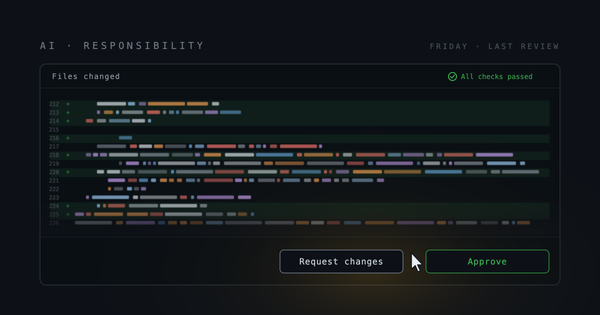
The third is the one I take most seriously. Picture dozens of agent-built variants a day, each needing a blind ranking. Code review rubber stamping has been a problem for years, and at this volume the vibe test is the next rubber stamp. The title survives and the judgment doesn't.
I think that's precisely why a role is better. It's a role, as opposed to another task for somebody who wears all the hats. The person who wears all the hats is judged and compensated for other things, and they're going to feel the pull of other tasks. Someone whose sole role is quality is paid, and their performance is judged, on the quality of the end product. They're more likely to put in the time, focus, and effort than an engineer with velocity pressures. If they rubber stamp, they won't be in their job very long.
I believe that answer. I also wrote a scene that argues against it.
Thirty questions
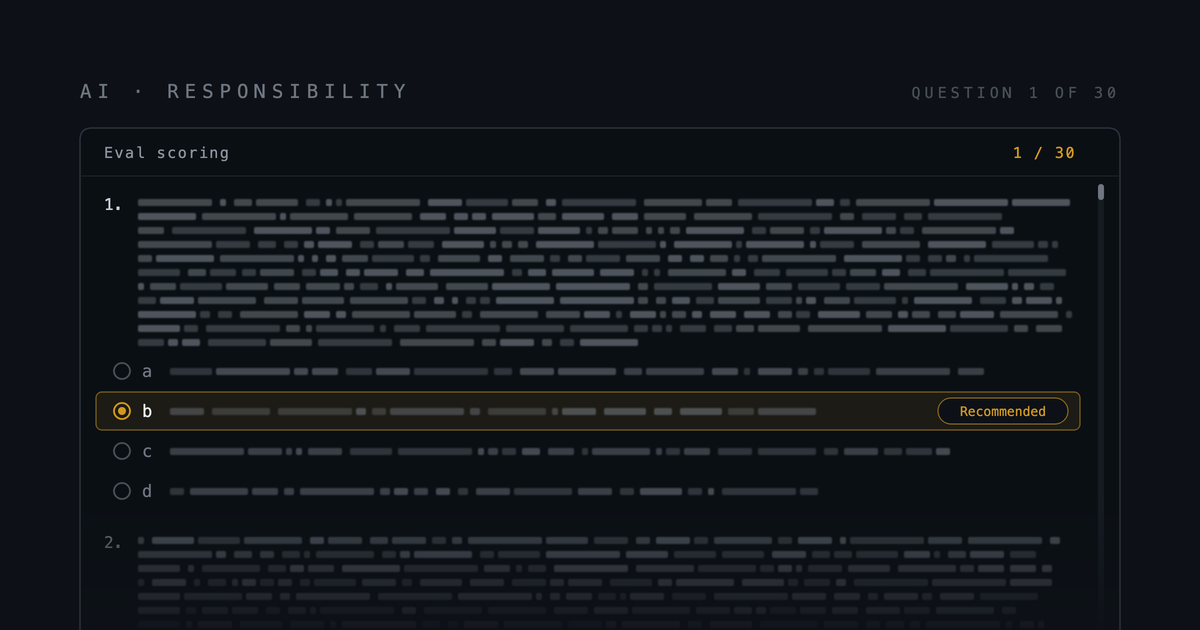
I've told the start of this before. This version is a composite, which I wrote as an exercise from real sittings with eval forms. I'd come off a long spurt of agentic development, hours of jumping from one parallel thread to the next, and I felt scattered. I wanted to keep spinning up threads. But the eval scoring task was the blocker. I opened the form and scrolled, and scrolled, and it seemingly didn't end. Just a massive wall of text. At the bottom I saw there were 30 questions. This was easily going to take an hour.
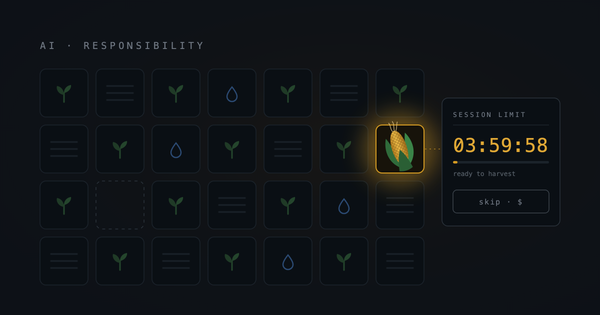
I went back up to question one and tried to read. I looked over at my Claude app hoping for a thread ready for my interaction, that Farmville crop ready for harvest. There was nothing, just this question. It wasn't just long, it was dense and deeply technical. I read the whole thing, and I didn't feel like I understood a word of it. But Claude gave me a recommendation for answer b, and nothing looked inherently off about b at first glance, so b it was.
In the scene that's question 1 of 30, and I haven't skimmed. I've read every word. My rubber stamp answer is about incentive: give someone a job where quality is what they're judged on, and the pull of other work goes away. This is depletion. The person following the rule produces a bad answer anyway, and that answer looks the same as a careful one. That also weakens my rubber stamp answer, because nobody fires a tester for a bad answer they can't detect. And this wasn't a dedicated tester, and a form isn't a user interface. What carries over is volume. I don't know what the fortieth blind ranking of the day looks like. What I do know is that writing good human evals is work that requires a high degree of focus and care.
Some of it is the form. The one in the scene is long, dense and deeply technical, and that's what I can't follow after those hours of threads. I'm mentally depleted and don't have the focus available to me at that moment to fulfill the task at hand. I also feel strongly that an eval should give no recommendations, and if a user asks for one it should refuse. It needs to be blind to the user, because the habit of mindlessly taking recommendations in your daily flow will follow you into the eval.
I had one worse idea. Log the time a human spends on each question and lower the weighting for answers that seem skimmed. But time spent isn't attention. Someone running three other threads can leave the tab open for eight minutes and score as careful, and the fast, correct reader gets marked down. Yeah, I didn't think that scenario through. The only way to fully enforce attention would be to proctor it, and I can't see a company actually proctoring an eval.
Adding an unclear option catches ambiguity. Seeding the form with questions that have known answers catches someone answering wrong. Subjective rankings have no known answer, and I don't know what catches incomprehension there.
Who keeps doing it
I think the news for QA is good. The role still exists, it's a valuable contribution, and manual testing is where the real value can be generated.
I also think the pay is probably going to be manual testing pay. I don't see that necessarily going up, perhaps if somebody is very, very good at what they do. For those who want to keep an engineer type salary, their best bet is to fill out their skill set enough to move into the engineer role that wears all the hats.
Not all QA testers want to become engineers, so I don't think we end up with nobody left to do the vibe test. This could also be a good role for juniors. My hunch is that their judgment is a bit more locked into the trends of the time.
But my answer to the rubber stamp depends on a person who is kept on quality, and it doesn't say who stays when the best tester can earn more as an engineer. The value is going up and the pay likely isn't.