I Built My Own AI Fitness Coach. The Workout Plan Was the Least Useful Part.
I built an AI fitness coach in Cowork — no code. The plan it wrote was the easy part; the value was a coach that flexes around illness, injury, and a chaotic week without the whole block falling apart.

Ask most people what an AI fitness coach would do and they'll describe a chatbot that spits out a workout plan. That's the easy part. It's also the part that mattered least.
I built my own AI fitness coach this year. No code — just a long back-and-forth in Cowork, in plain English. The program it helped me write was the smallest thing I got out of it. The real value showed up afterward, in the weeks when a stomach flu, a foot injury, and a tweaked back hit across one rough stretch and the whole plan didn't fall apart.
That's the useful insight for anyone curious about using AI outside of work. The real value is mundane: staying consistent and honest, week after week, while real life keeps trying to break the plan.
Why did my rigid workout plans keep falling apart?
Two things kept wrecking my training, and both got worse in my 40s.
The first is me. I've been lifting as a hobby for over 20 years, I know how to push hard, and left to my own devices I push too hard. Same as I did at 25. It feels great for a week or two. Then the sleep goes first — I start waking at 5am the morning after a heavy session, wired and under-recovered. Then energy drops. Then something tweaks, and I'm hurt.
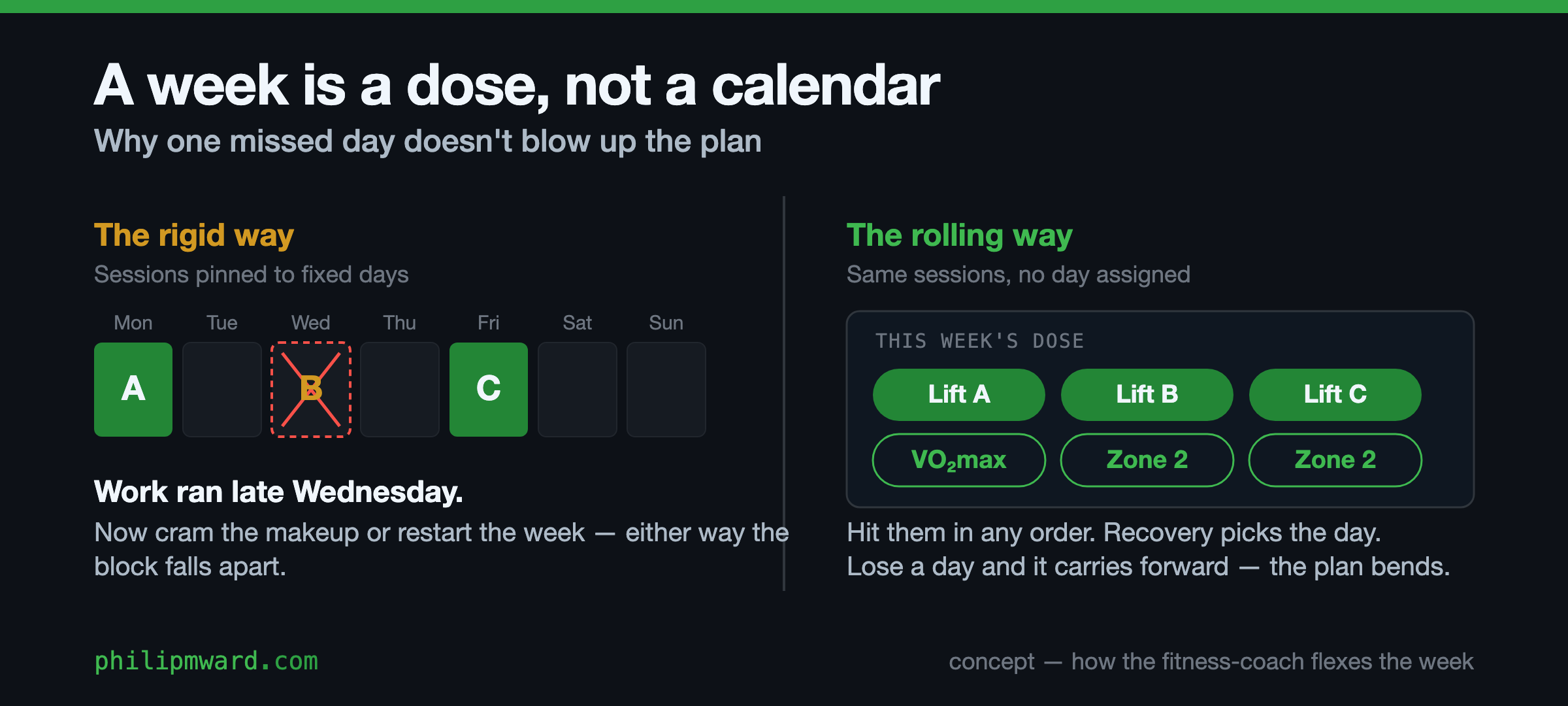
The second is life. A work night runs late. The next evening my wife needs a hand with something. Miss two or three unplanned days and a rigid Monday-Wednesday-Friday split is already broken. Do I cram the missed sessions? Start the week over? Every time, the rigidity is what snapped first.
So a smarter program was never the fix. I needed one that could bend without breaking, and that would stop me from digging my own fatigue hole.
Why build my own instead of hiring a trainer or an app?
I've done the trainer thing. I've worked with real coaches and had my form checked in person, so I know what good coaching feels like. That experience is why I didn't hire one this time. Most trainers don't know much more than I do at this point, and none of them know my body and my history the way I do after two decades of paying attention.
I'll give the other side its due: a great in-person coach still beats a tool at the things a tool can't do. Watching your form on a heavy set. Reading the fatigue on your face. AI doesn't win there. It wins on consistency, memory, and holding the line week after week, which is exactly where I keep failing on my own.
Apps have the opposite problem from a good coach: they're rigid by design. They assume the clean week I never actually get. So I built the thing I wanted, and I built it to ground every rule in real research, not gym lore.
What the fitness-coach actually is
It's a coaching skill I talk to. It reads and updates two files every session, a coaching-notes doc and a tracker, so it always knows where I am without me re-explaining.
The core idea is that a week is a dose, not a calendar. Instead of "Monday is squats," the week is a target: three lifting days on a rotation, plus three conditioning sessions. Hit the dose in whatever order recovery, travel, and a cranky foot allow.
The engine underneath is autoregulation — adjusting each session's load to how recovered I actually am that day, instead of forcing a number off a fixed percentage of my max. Feeling strong? It lets me push. Slept badly, or coming off a bug? It pulls the load back on purpose.
I'd used autoregulation before and still overshot; knowing the rule and obeying it on a day I feel strong are two different things. What's new is a coach that holds the line for me, and remembers that on my own I won't.
I didn't invent autoregulation, and this is where the "grounded in research" part matters: it's a well-studied approach. A 2025 systematic review and network meta-analysis found autoregulated training outperformed fixed percentage-based programs for building strength, though earlier reviews put the two closer to even (external research, not something I measured myself). More to my point, scaling the load to how recovered I am, rather than to a fixed number, is what keeps me out of the fatigue hole. That's why I built the coach around it. And it's why I'll say plainly: this is how I built my tool, not a prescription for your body.
The part that pays off: flexing around real life
The best test came early, and it came as a pile-up. Inside a few weeks I got the stomach flu, then a foot injury flared, then I tweaked my back. In the past, any one of those would have blown up the whole block and sent me back to week one, or back to the drawing board for a new program.
Here's what the coach did instead of throwing out the plan:
- It shuffled the remaining sessions into whatever order my week allowed.
- It pushed the days I lost into the next week and carried the debt forward. No cramming on my first days back.
- It benched the moves that aggravated my foot (stair stepper, jumps, calf raises) and subbed in replacements, so I kept training everything else while the foot settled.
- After the back tweak, it pulled the intensity down and eased back up over the next few sessions.
None of that is heroic. That's the whole point. In my words at the time: it stopped me from overthinking it. The plan survived a genuinely rough patch because it was built to flex, and I kept moving forward through weeks that used to cost me the entire block.
The quiet feature I underrated: it remembers everything
Every one of those tweaks got written down. Not by me — by the coach, into the log, as we made them.
Going in, I thought the advice was the product. It turns out the record is half of it. Every load and every swap is now searchable history I can point the coach back at. "Last time my foot flared, what did we pull, and how long until I reintroduced it?" It gets better the longer I run it, because it isn't starting from zero each time. It remembers. That's the compounding part, and it's the part a fresh chat with a generic chatbot can never give you.
Why this isn't "ask ChatGPT for a workout plan"
If you just ask an AI for a program, you'll get a generic program. The quality came from not doing that.
I didn't prompt it once and accept the output. We went back and forth until the thing matched what I already know works for me: the lifts I respond to and the volume I can actually recover from. I was clear and specific about what I wanted, and inside those guardrails I let the model make the judgment calls.
That's the same instinct behind everything else on this blog: be explicit and deterministic where you have strong priors, and spend the model's judgment only where judgment actually earns its keep. The same instinct carries straight outside code. Set hard constraints from what you know; delegate the rest.
One more thing, because "let AI coach you" sounds like handing over the wheel: I'm not outsourcing my training. It's a working relationship. The coach makes decisions easier — it doesn't make them for me. When it suggests something my body disagrees with, I overrule it, and it logs that too. I keep the veto. I always keep the veto.
What you can actually take from this
You don't need to care about squats to use any of this.
The method copies over to a lot of things, and it needs zero code. Pick something you already understand well. Sit down and have a real conversation with an AI about how you want it to help: the rules you want it to follow and the way you want it to track things. Then iterate until it reflects what you actually know, and let it run.
The honest catch: the quality ceiling scales with what you bring. I got a coach that, for me, beats most trainers because I brought 20 years of knowing what works and kept refining until the tool matched it. Come in cold and you'll get something more generic. That's still genuinely useful (a patient, always-available tool you can shape over time), just don't expect elite results from a one-line prompt.
So here's the rule I'd leave you with. Don't ask AI to be the expert. Bring the expertise, and let AI be the thing that keeps you consistent when life gets in the way. That's where it earns its keep — in the gym, and everywhere else.
FAQ
Do you need to know how to code to build an AI coaching tool like this?
No. I built mine entirely in Cowork through plain-English conversation, no programming. The skill is defined in natural language, and it reads and updates its own notes and tracker each session.
Isn't an AI coach just going to give you a generic plan?
It will if you ask it once and accept the first answer. The quality comes from iterating: bring what you already know and refine the plan over several rounds until it fits you. The value is less in the plan it writes and more in how it adapts that plan around illness and a messy schedule over time.
Can AI replace a human personal trainer?
Not for everything. A good in-person coach reads your form and fatigue in ways a tool can't, and that's worth paying for if you need it. Where the tool wins for me is the boring stuff I kept dropping on my own: showing up every week, and remembering what happened the last time.