Why I keep the friction — the un-automatable life
Fulfillment is the thing that can't be delegated. Two lists, a rule for what to hand the machine, and why my hands stay on the keys.
The recital
I started playing piano in January. Partly because I love music, and partly because I love a challenge. I have played guitar for over thirty years, and somewhere along the way I began to lose interest. I suppose growing old and losing the youthful hopes and dreams of becoming a rock star probably had something to do with it. But at the same time, part of what I loved about guitar in my teens and twenties was the challenge. The feeling of bashing my head against a difficult guitar solo until my fingers bled, and in the end watching others' jaws drop as I ripped through it at lightning speed. That payoff made the countless hours of work worth it. The greater the challenge, the greater the payoff. More on that later. Challenging virtuosic guitar pieces are surprisingly limited, both in number and in genre. Piano on the other hand has an inexhaustible quantity of virtuosic pieces for me to bash my head against. It also happens to be a better solo instrument, with no real need for a backing band. I am the percussion, the bass, the rhythm, and the melody all at the same time. Which is why I chose to pick up the piano in January.
Three months after picking up the piano, I performed Chopin's Prelude in E minor at a recital. It's not the most technical piece in the world, but it is very difficult to play well, because the emotional demands are extremely high. My teacher didn't discourage me even though the piece was well above my level. He helped me through it every step of the way. We'd spend the first half of each lesson on the grade 1 workbook stuff I was breezing through, and the second half digging deep on the piece. On top of that I put in about an hour of practice a day on average. It was hard. At times it felt impossible to polish the piece to performance levels in time, especially getting the emotional outburst and resignation that define the middle of the piece just right. But at the end, my teacher said I'd pulled off a very convincing performance, and that it was the first time he'd seen someone with less than five years of experience manage that piece convincingly.
And now the piece is easy to play. I can sit down anytime and run through it, no problem. I became a better piano player from it, and I'm onto the next challenge. The real payoff.
Nobody made me do any of this. Every hour at that piano was chosen. I'm a mid-career engineer with a full life; no part of it required a recital. And I did it in the same year my whole industry is racing to remove effort from everything it touches. I work in AI. My job is teaching machines to do hard things so people don't have to. So I owe myself an explanation for why I keep choosing hard things on purpose.
The decade that almost slipped away
I haven't always chosen well. Through most of my 30s I spent so much time grinding on my career that, in hindsight, the whole decade feels almost like a waste. That's my particular failure mode. I get too wrapped up in my current goals, in the things I'm working toward, and I don't appreciate the things I have until they are gone. I don't think I'm the only one. I think this is a trait common to many of us.
What broke the pattern was a crisis, and I want to be honest about that, because it matters later. A few years ago my mother had a traumatic brain injury. I took pause afterward, and I really understood for the first time how limited our lives truly are. How easy it is for time, our most precious commodity, to just slip away. Tomorrow is not guaranteed. I was spending too much of it on things that weren't my highest priorities, and not enough on the things that were. So I made a conscious change to bring more balance into my life. To spend more time with friends and family. To stop obsessively saving and investing, and start traveling more. To start aligning my time and effort with the things that matter most. Not coincidentally, this is the time when I met my wife. That's when I started building a garden in the desert. That's when I started playing piano.
The best frame I have for the change is intentional living versus autopilot. On autopilot I am not in control. My career, other people, and my thoughts about what other people think I should do become the guiding force in my life. And autopilot never feels like a crisis while it's on. The plane stays level. The days coast by. That's what makes it dangerous; nothing about a comfortable cruise tells you that nobody is choosing the destination. When I'm intentional, I stop being a character in the story that things happen to, and start becoming the author.
What the hard things pay
Author is a big word for a man with dirt under his fingernails and a grade 1 workbook on the piano, so let me be concrete about what each hard thing actually pays.
The piano gives me a form of self-expression, a way of really sinking into various emotions, especially the Romantic-era works like Chopin and Beethoven. It's very healing.
The garden connects me to nature, and if I'm not in regular contact with nature, I get depressed. There's a real difference in my mental health between me in a desert summer with a barren rock backyard, and me in a desert summer with a lush green yard growing bananas, peaches, citrus, watermelon, squash, beans, cantaloupe, sweet potatoes, and Armenian cucumbers. Putting my hands in the soil and growing my own food has turned into one of the most fulfilling things I've ever done. I think it's a genetic part of the human animal. I'm only the second generation in my family removed from the farm. Some of my fondest childhood memories are on my grandparents' farm in central Michigan.
And there's a third hard thing I haven't mentioned. The gym. That one didn't start with the pivot; I've always prioritized keeping my body strong and healthy. But my mother's injury gave the workouts a new role. A strong body is key to healthy aging. Working out keeps my body strong, helps stave off the type 2 diabetes that runs in my family, gives me energy, and helps me age well enough to keep up the hobbies I love long into old age. I want to be that 90 year old guy on the hiking trail.
These hobbies all pay. They aren't just work for the sake of work. Though the challenge keeps them interesting. And the value doesn't stay in its lane: the success I've had in my career owes a lot to things I learned pursuing these challenging hobbies. Working under the barbell week after week and then hitting the PR you thought was impossible teaches you something about how to tackle and manage hard long term problems that no 2 week sprint retro ever will.
And none of these hobbies drifted into my life on their own. Each one got written in on purpose.
The rule, and the crack in it
Here's where AI comes in, because from the outside my relationship with it looks like a contradiction. The man preaching intentional living now flies most of his work on autopilot. I'm hands-off on the code I churn out at work, and hands-on at the piano, in the garden, under the barbell.
The honest reason starts with what happened to my career. I lost my passion for it for a number of years. It stopped challenging me, I stopped learning new things, layoffs were rampant, office politics wore me down, and it just stopped being fun. AI brought the fun back. I'm learning again, and it challenges me as an engineer: can I build autonomous loops at work? Can I build tools to help me in my personal life? Can I build the perfect blog workflow? That is enjoyable. Doing manual research, editing, and fact checking for this blog, coding by hand — these days those things just sound like work to me.
So here's the rule I actually live by. Keep the layer that still challenges you, and hand off the layer that's gone inert. My challenge migrated up a level, from writing the code to designing the system that writes it, and I handed the dead layer to the machine gladly. That's what an autopilot is for. You don't hand-fly the long boring cruise out of principle; you save your attention for the legs that still need a pilot. Used deliberately, the autopilot is the pilot's tool, and switching it on is itself a choice. The intentional life doesn't forbid delegation. It insists you're the one deciding what gets delegated.
But the rule has a crack in it. The frontier recedes. The layer that challenges me today will be routine in a few years, and AI is climbing the stack right behind me. If challenge were my whole reason for doing hard things, my own rule would eventually hand everything off, one gone-inert layer at a time, until nothing was left in my hands. The autopilot flies more legs every year. Follow the rule far enough, and one day the plane doesn't need me for anything, and I'm back to being a character: strapped into the cockpit of my own life, along for the ride.
The chip
There's an old philosopher's thought experiment about exactly this. Robert Nozick asked: if a machine could give you any experience you wanted, indistinguishable from the real thing, would you plug in? Make it concrete. Suppose a chip could give me the identical emotional experience of playing that Chopin prelude (the built tension, the outburst, the release) with zero finger work and zero practice. Do I take it?
I keep playing by hand.
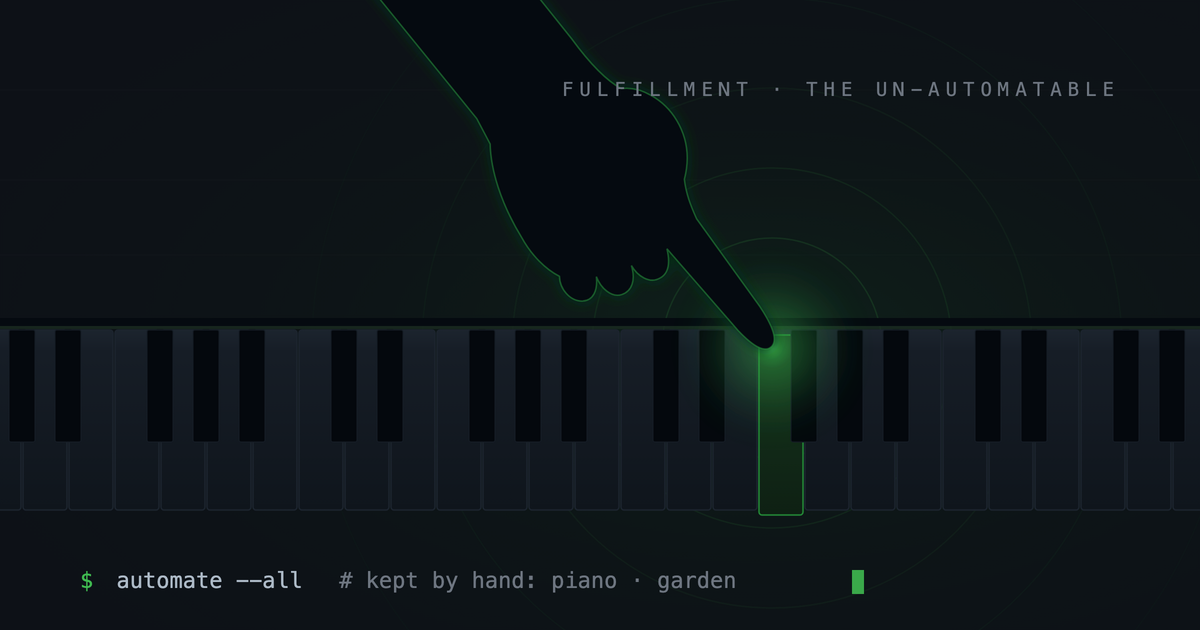
Playing piano and growing a garden are chosen hobbies, chosen partly because they can never be automated. They provide something an automated flow never can. Fulfillment. Fulfillment is that payoff mentioned earlier, and the chip could copy the feeling of it, in full. That's exactly what exposes it. The fulfillment was never the feeling; it was having done the thing. The Chopin piece fulfills me because I worked that hard for it, and no chip can make it so that I did. An easy piece that I can sight-read doesn't give the same fulfillment as the piece I had to struggle for. Exactly why the guitar got boring after 30 years.
And the chip carries a quieter cost. The feelings would still arrive, vivid as ever, but nothing about them would be authored.
The cleanest way I can show this is through a sorting exercise. There are things I will retire from. Work, someday. This blog, someday too, and I'll be honest about that: writing it is fulfilling right now because it's a creative exploration, and eventually this creative flood will slow to a drip, and I'm sure I'll move on and find something new to explore. That kind of fulfillment lives in the exploring, and exploring ends. The piano's lives in the doing, and the doing doesn't. Then there are the things I don't plan on ever retiring from until and unless my body forces me to. Piano. The garden. The gym. The hiking trail. Everything on the first list can be delegated. Nothing on the second list can. The lists sort themselves on that one test.
The peach
A scene from the second list. I walk out into my garden and find a fresh peach waiting for me on the tree. I pick it and take a bite. Sweetness washes over me, then a feeling of contentment. This isn't a peach I bought at the store; it's from a tree I planted with my bare hands and have tended for years. There is nothing like the taste of a freshly picked peach, and it's kind of sad that most people may never experience it. They'll only ever have the store-bought box-ripened kind. So much of life gets delegated away, to companies, to AI, to robots. And around me the ecosystem I built is working with me: the birds, the bugs, the microbes in the soil, all thriving because of the work I put in, all making my job easier by feeding my plants.
Technological advances keep handing us more free time, and you'd think more people would spend it building something like this. From what I can see, most of the freed time goes back into screens. Inside, alone, attached to one screen or another. I call that a technological prison, and I mean it. I do believe social media, video games, and apps are built for addiction, not fulfillment. And every one of those feeds has an author. It just isn't the person scrolling it. An evening in the algorithm is an evening spent as a character in somebody else's story, tuned so you never want to put it down.
But I have to bend on part of it, and the bend matters. The utopia in my backyard is mine, and we are all individuals. Connection with nature doesn't necessarily mean gardening for everyone. It could just mean some extra time sitting on the porch instead of inside in front of a screen. By nature I'm a bit of an introvert, so many of my fulfillments run solo; someone more extroverted might need a lot more community in theirs. For that matter, even I need more community than my hobby list suggests. The substrate looks universal to me (some real contact with nature, some genuine give-and-take with other people), but the form is tuned per person.
And remember what it took for me to find my form. Wisdom didn't get me there. A crisis did. I have no standing to lecture anyone about their autopilot when only my mother's injury broke mine.
The ledger
Before I say anything more about screens, the claim deserves a fair test. Picture two people alone in two rooms, one at a piano, one at a video game. From the doorway they look identical: a person, an instrument, total focus. I've tried to name the difference and I can't fully do it. The piano feels more real to me than the game, the way a conversation face to face feels more real than a comment thread on TikTok, and I can't really put into words why. But it is. The word "game" itself perhaps provides a hint. A game can be reloaded. The consequences of the decisions made inside it don't reach the player's living world.
Except they do, a little, and here I have to testify against myself. I play video games. Less than I used to, mostly because I noticed that when I play too much, I feel worse. Less energy. Less happy. Less fulfilled. Less able to focus. The dopamine drain is real, at least for me. The game reloads; I don't.
So the line I trust runs somewhere different. It runs through what a thing leaves in you versus what it takes out of you. Call it a ledger. Playing piano, for me, deposits: it builds character, it heals, it's a release, it's a creative outlet. Playing a video game, for me, takes back what it gives. And notice the ledger belongs to the activity and the person, never to the medium. Building a video game might be all deposit — that act of artistry, of creating something for someone else to experience. Screens can deposit too. I know multiple people who met their spouse online. Online can help people form real connections, and it can be a way to hear positive messages, if you're deliberate about who you follow. Screens are not innately bad. But the algorithms that run most of them have been tuned, I'd argue, for maximum addiction as a profit-maximizing technique, and when the neutral technology becomes an addiction, it is no longer truly neutral.
The ledger cuts against my side of the doorway as well. Beethoven is the great lesson in the good hobby that went to withdrawal. His art became his identity. Then he went deaf, and I can't imagine that suffering: he composed some of his best music after his hearing was all but gone, and he could never hear it. Think about that for a moment. We all can experience the gift he created, and he never could. His own letter from the years his hearing was failing, the Heiligenstadt Testament, records how close the despair took him to ending his life. He didn't have balance. When he was robbed of enjoying the thing most important to him, he had nothing else to fall back on. A deposit that deep still flips when it's the only account you hold.
The same goes for me at my own scale. Even playing too much piano can be bad. Injuries happen, and I could hole up in my room with it and miss out on life, community, experience, my beautiful wife. I'm not getting on a soapbox saying nobody should ever play video games. Everything in moderation, read off your own ledger, at your own dose. Balance in all things.
What I keep
So that's the shape of the answer I owed myself. Two lists, sorted by whether the doing can be handed off. For the first list, a rule: keep the layer that still challenges you, hand off the inert one, and let the machine have it without guilt. Under the second list, a floor the receding frontier can't touch, because the reason down there was never challenge. It's fulfillment, and fulfillment can't be delegated. That's the intentional life as I can build it. I take the author's seat.
The chip isn't hypothetical forever. Some version of the frictionless life is coming for each thing I do, and it will arrive with the feeling included. When it gets here, I expect to do what I did in March. Sit down. Build the tension properly. Keep my hands on the keys. The autopilot can have the cruise. The landings are mine.
You may have noticed this is the second essay like this here, after Yoshimi Battles the Pink Robots. They're now a regular part of the rotation: roughly one reflective piece a month, threaded between the technical posts, as they're ready. These pieces take a lot more time and effort on my part. That also makes them very fulfilling. If the practical material is why you subscribed, that stays the spine. If these philosophical posts are the ones you enjoy, there are more coming. Hopefully, you enjoy both. The how and the why, side by side. Balance.